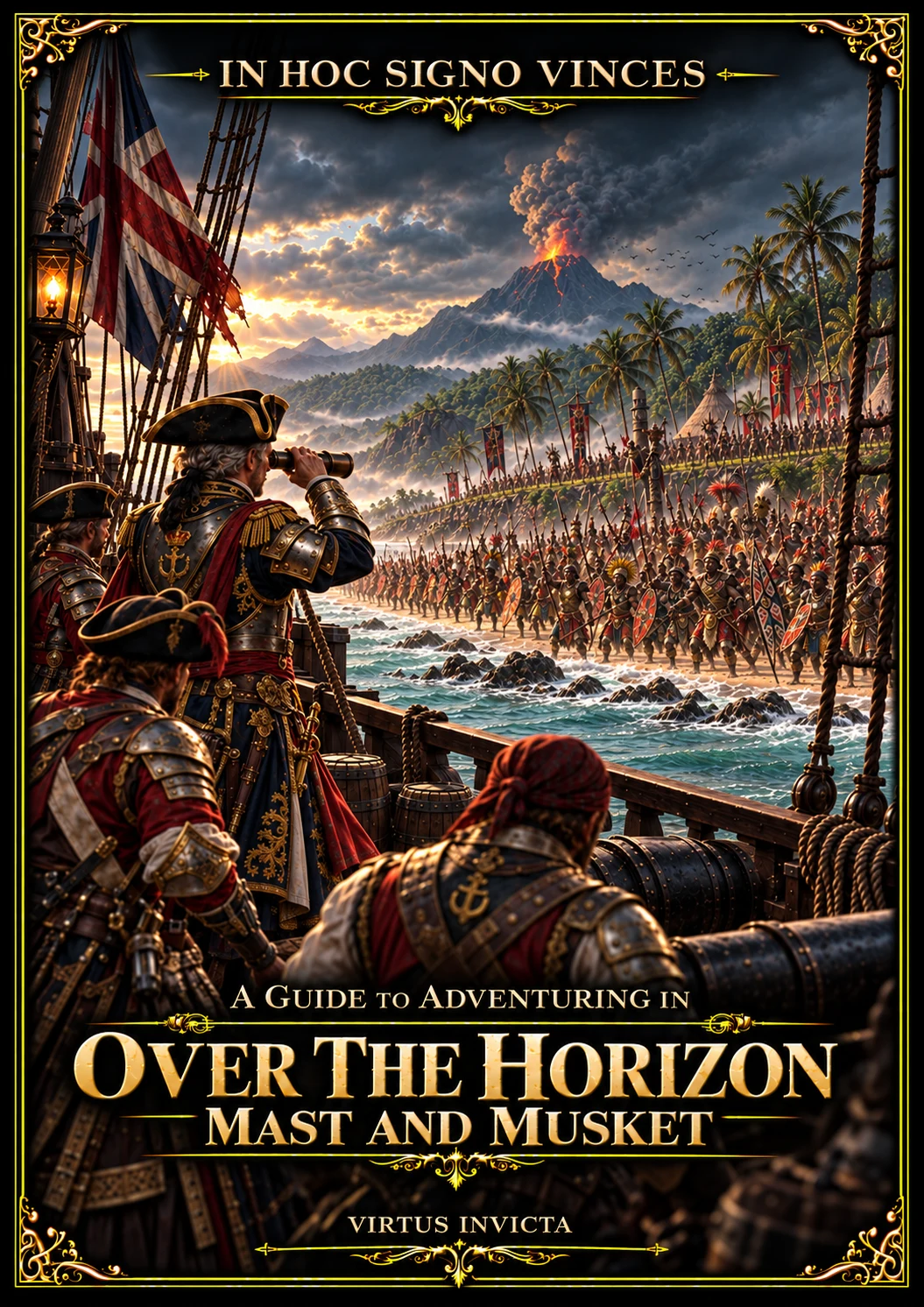
Book VII
Over the Horizon
The world beyond the Narrow Sea as Britannia knows it — a public guide to the near coast, the northern world, the Dead Sea Basin, the far continents, and the trade that reaches them.
“A contract executed in Britannia is evidence of what two Britannians agreed. It is not, on this quay, a thing anybody is obliged to do anything about. I have explained this to eleven houses and been thanked by two.”
“There are two peals and one code and every child here knows both. I will teach you the first this afternoon. The second you will learn the night you hear it, and I have heard it twice in fifty-one years.”
“The Great Isle’s foundries, warship yards, artillery works, workshops and mast compounds devour material faster than domestic ground can always supply. Everything else written about the outward business is commentary upon that sentence, including the parts that are meant kindly.”
From the opening
The World as Known from Britannia
“A Briton sees the world from a quay. That is not a limitation to be apologised for, it is simply where he is standing, and every account he gives of a distant country will be an account of what reached that quay and of who carried it.”
Everything in a British account of the world is drawn from a single position, and the position is a harbour on an island. That is the honest starting point and it explains more than any other single fact about British geography. The world is known outward from the water, in the order the water reaches it, at the pace the trade has found worth paying for.
The consequence is that British knowledge is deep where it is narrow and absent where it is broad. A stretch of foreign coast with a paying port on it may be better charted than a British county. The country behind that port, a week inland, may be a blank crossed by a dotted line copied from a traveller who died before he could correct it.
This is not ignorance and should not be read as ignorance. It is a shape. Knowledge has followed money along particular threads. Where the money went, the knowledge is excellent, current, kept up annually by men whose living depends on it. Where no money went there is nothing, and the nothing is often adjacent to the excellence.
What a reader must give up is the idea of a world evenly known and then unevenly described. The British world is a set of well-lit threads in a very large dark room, and the threads are the lanes, ports, stations, and concessions. The useful order therefore follows those threads as the trades found them, not the order in which a globe would present them.
The position has a second consequence that Britons notice only abroad. A country known from its water is a country known from its edge, and an edge is where a people puts the things it wants watched. Quarantine grounds, powder stores, the burial places of those who died at sea, the shrines that keep the lists and the relics that make a harbour worth a pilgrimage: all of these sit within sight of a quay in almost every port the trade touches. A British account of a foreign nation is therefore an account of its margin, assembled by men who were looking at the most guarded part of it, and the honest writers say so.
The corollary is that the interior of every country in the known world is described in British books by people who did not go there. That is true of the Black Continent and it is true of Lyonnais, where a British factor may have crossed the same eleven leagues for twenty years without once turning inland. The difference between the near circle and the far is not that one has been entered and the other has not. It is that in the near circle somebody can be sent to check within the fortnight.
The doctrine that governs all of it is simple and is applied by the chart office quite consistently. What is drawn is drawn as certainly as it is known, and where it is not known the chart says as much. A map that hides its uncertainty is regarded in the office as a bad map regardless of how much of it is right.
Contents
Part I — The World as Known from Britannia
- 1 Circles of Certainty, and Where They Stop Enhanced members
- 2 What Is Known, and How Anybody Knows It Enhanced members
- 3 The Makers of Maps, and Why Wrong Ones Persist Enhanced members
Part II — Sea, Sky, and the Trade That Pays for Both
- 4 The Sea Lanes, and What They Actually Carry Enhanced members
- 5 The Sky Lanes, the Masts, and the Prestige Enhanced members
- 6 Sea Before Sky, and the Arithmetic Behind It Enhanced members
Part III — The Offices That Actually Matter
- 7 The Harbour Syndic, and the Season a Cargo Can Be Held Enhanced members
- 8 The Beacon-Master, and the Light That Was Not There Enhanced members
- 9 The Insurance Notary, and the Sentence That Ends a Voyage Enhanced members
Part IV — The Near Coast
- 10 Twenty-One Miles, and What a Traveller Expects
- 11 Lyonnais, and What a Banner Court Is
- 12 The Colour Cities, and Friendships That Are Sold
- 13 The Near-Coast Ports, and Port Leonis
Part V — The Nieuwlanden, and What Is Behind Them
- 14 Dike, Lock, Causeway, and Bell
- 15 The Sluice Court, and the Towns Built Twice Enhanced members
- 16 The Last Bank, and What Nobody Will Cross It For Enhanced members
Part VI — The Northern World
- 17 Prussland, and an Order That Permits a Market
- 18 The Free Ports of the White Lands
- 19 The Northern Cities, and the Raiders Beyond Them
Part VII — The Dead Sea Basin
- 20 The Inner Sea, and Its Terrible Doubleness
- 21 The Central Ports, and the Discipline Each Teaches
- 22 The Western Crescent, and the Courts of Ash
- 23 Fair Weather, and Why It Is Feared Enhanced members
Part VIII — The Black Continent
- 24 The Edge Ports, and What a Station Really Is
- 25 The Interior, and the Ordeal of Crossing It
- 26 What Comes Back, and What It Costs to Get Enhanced members
Part IX — The Western Continent and Asia
- 27 The Western Continent, and the Legend Attached to It
- 28 Asia, and a Refinement That Is Not Exotic
- 29 The Long Routes, and the Year They Take Enhanced members
Part X — Colonies, Stations, and Concessions
- 30 What a Colony Is, in Practice Rather Than in Speeches Enhanced members
- 31 Treaty Ports, Bonded Depots, and Fortified Islands Enhanced members
- 32 The Concession, the Mine-Field, and the Local Bargain Enhanced members
Part XI — The Charter Houses and the British Apparatus
- 33 The Four Charter Houses of the Outer Sea Enhanced members
- 34 Convoy Fraternities, Factors, and Foreign Credit Enhanced members
- 35 Legation, Consul, and the Resident Who Must Be Believed Enhanced members
Part XII — Doors Over the Horizon
- 36 Who Hires for Distance, and Why Enhanced members
- 37 What Is Wanted Out There, and in What Coin Enhanced members
- 38 Twelve Commissions, Costed and Clocked Enhanced members