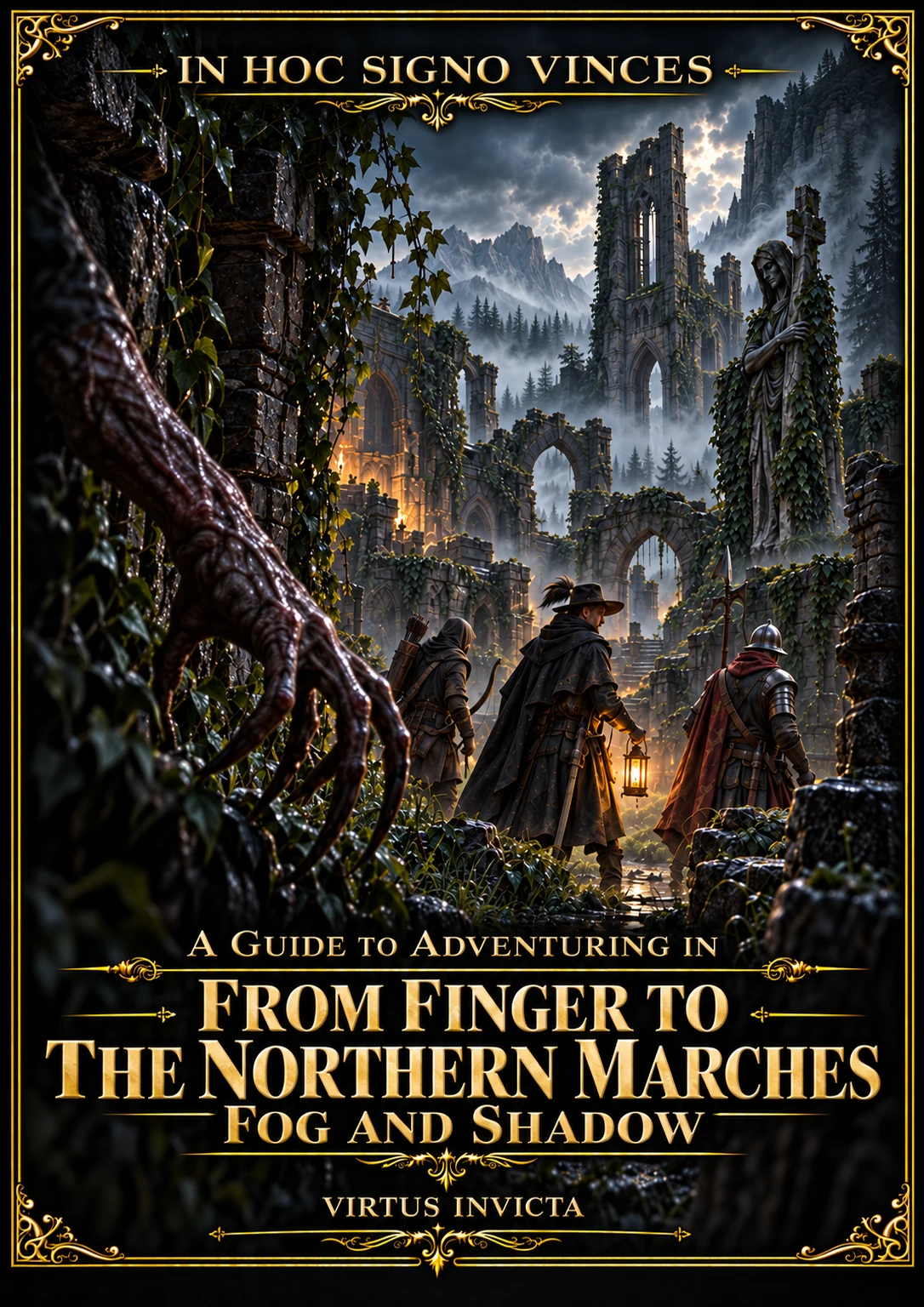
Book VI
Fog and Shadow
The Northern Marches, Harrowgate, and the ground that lapses — a public guide to the bounding, the powers that hold the north, and the country that is kept, lapsed, or given up.
“A bound stone is not a monument. It is a witness that cannot be bribed, cannot forget, and cannot be called to the assize. That is three virtues and one grave defect, and the defect is why we still strike children.”
“Four ways to the stone and not one of them a road. That is not four chances. It is the shape of a place that men have kept trying to reach and have never settled how.”
“Six wagons, four generations, and a circuit we have kept since before the priory kept a book. We are not from anywhere and that offends people, so they invent reasons to dislike us that have nothing to do with anything we have done.”
From the opening
Where the Marches Are
“From the Finger to the Northern Marches, they say, meaning everywhere. It is worth noticing which end of that saying the realm chose to hang its word for the edge of things on, and worth noticing that the other end is a headland and this end is a country with people living in it.”
The realm has an idiom for everywhere, and the north is one of its two ends. From the Finger to the Northern Marches is what a man says when he means the whole of Britannia, and the phrase is old enough that most people who use it have never been within two hundred miles of either term. The southern end of it is a headland. The northern end of it is this: a stretch of upland, wet country and wood, with a market town in the middle of it, several thousand people living in it, and a great deal of ground in it that nobody enters.
The county exists on paper. It has a name, a sheriff, a shrievalty, a line drawn round it, and none of that is false. Writs run here. Taxes are assessed here, and mostly collected. The assize comes north four times a year and hangs men, which is the most visible thing the Crown does in the district and is not the most important. A traveller who arrives expecting an absence of government will be surprised by how much of it there is, and will be surprised again, some weeks later, by how little of it reaches the places where it would matter.
The shape of the ground is four countries and they are not administrative. There is upland in the west, the High Wold and the fells behind it, where the drove roads run and where the barrows are. There is wet country in the east, the meres, the carrs and the reed grounds, which is crossed by boat or by causeway and otherwise not crossed at all. There is Wychwood in the south, which is a wood in the old sense and has a court of its own. And between them there is the fallow country, which is the ground that used to be something.
Harrowgate sits near the middle, on the only road that crosses the district end to end, and is the seat because a priory was put there in the years after the Apocalypse and everything else gathered round it. It has a market, a gaol, a bridge, a corporation and about four thousand souls, which makes it a modest town in the south and by far the largest thing most people in the march see regularly. The three districts beyond it are reached in two days, three days and four days respectively, in good weather, which is a phrase doing a great deal of work.
Distance is the first fact about the march and it is not a romantic one. Westminster is eleven days from Harrowgate by the ordinary post, rather more in winter, and an answer to a letter is therefore a month if the thing is urgent and a season if it is not. The bishop is at the county town, which is five days. The nearest house of the Collegium is further than either. Every institution a marcher might appeal to is at the far end of a journey that takes longer than the thing being appealed about, and the district has arranged itself accordingly.
The obvious southern objection is the skyship, and it does not alter the arithmetic. Harrowgate has no public receiving mast, no scheduled aerial service and no permanent ground establishment for routine arrivals. A Crown or private vessel can be sent north for exceptional business, carrying officers, messages or a compact costly load far faster than the road, but the service cannot be summoned by a parish, does not carry the ordinary post, and is least dependable in the bad weather when the March most needs help. Fuel, skilled hands and replacement gear still have to come up from the south, and the district has too little high-value traffic to pay for a permanent yard. The March therefore reckons institutional distance by road, not because aerial travel is unknown, but because it is exceptional rather than infrastructure.
What follows from distance is the whole character of the place. A district that cannot fetch help inside a fortnight does not fetch help. It settles the matter itself, or it does not settle it, and both of those have left marks all over the ground. The rites a parish performs at its own charge, the stones it sets up, the ground it agrees without any order to stay out of: these are what a district does instead of sending south, and they are the subject of very nearly everything a stranger will find puzzling here.
One consequence of all this distance is worth putting at the front, because a stranger meets it before he meets anything else. Every remedy this country has against the unseen is a local remedy. A parish that wants a rite performed performs it itself or waits a season. A district that wants ground looked at sends for a brother of the priory and is fourth in the queue. There is no authority within reach that can be made to come quickly, and the whole apparatus of lamps, bells, stones and watches that a visitor finds so striking is what a country builds when help is eleven days away.
The other thing to know about the ground is its age, and the march is unusual in the realm for how much of it predates the ruin years. There are works in this district older than any record anybody holds, and the settlements sit among them rather than upon them: a village with a stone in its field that the village did not set, a road that bends around something, a chapel built against a wall of unknown make. What the district does about them is uniform and is not curiosity. The stone is not moved. The road is not straightened. The chapel is consecrated on the side that faces the village, and the wall it is built against is not. A marcher asked about any of this will say it has always been so, which is true, and will not say more.
The realm measures in miles and reckons in leagues of three, and the march can be put in those terms although it rarely is. Harrowgate stands about two hundred and eighty miles north of London by road, which is eleven days for the ordinary post and rather more for anything heavy. The county town, where the bishop sits, is a hundred and thirty miles south of it. Cambridge is the nearer of the two schools, is the last place northward with a through road worth the name, and lies a little over two hundred and thirty miles off. No scholar of it has come here within the record.
One administrative distinction should be fixed before the terms begin multiplying. Harrowgate is the seat of the march, not the county town. The sheriff’s higher office, the bishop, the nearest Collegium house and most of the machinery by which the county speaks southward are in the county town a hundred and thirty miles away. Harrowgate is the northern working seat: it has the under-sheriff’s people, the assize when it rides, the corporation, the priory, the market and the books the march actually uses. A marcher who says the seat means Harrowgate. One who says the county town means the place five days south. Confusing the two makes the Crown look more present here than it is and Harrowgate more powerful than it is.
What lies west of the march is a question the district answers badly and does not think worth answering. There is country westward that nobody here administers, into which no writ of this shrievalty has ever run, and which the drovers describe as much the same ground under quite different customs. Whether it is a march in the sense this county uses the word, whether it has a seat or a sheriff of its own, and where the two would meet if anybody walked between them, are questions no officer at Harrowgate has been asked and none has gone to answer.
Contents
Part I — The March at a Glance
- 1 The March, and Where It Begins
- 2 The Look of It, the Weather, and the Short Year Enhanced members
- 3 Kept, Lapsed, and Given Up: How a Place Is Spoken Of Enhanced members
Part II — Harrowgate, and What a Seat Is For
- 4 The Town, the Priory, and the Market
- 5 The Assize, the Gaol, and the Long Ride to It Enhanced members
- 6 What Harrowgate Answers For, and What It Does Not Enhanced members
Part III — The Bounding
- 7 Beating the Bounds, and Why It Is Not a Ceremony Enhanced members
- 8 The Stones, the Witnesses, and the Book Enhanced members
- 9 What a Lapse Costs, and How Long It Takes to Show Enhanced members
Part IV — The Powers, the Courts, and the Terms
- 10 What Holds Ground Here, and What It Wants Enhanced members
- 11 Spirit Courts, Tributaries, and Dangerous Peaces Enhanced members
- 12 Who Answers: The Three Orders and the Pact Families Enhanced members
Part V — The Wold, the Fells, and the Barrow Country
- 13 The High Wold, and the Ground Above the Drove
- 14 The Barrows, and Why Shepherds Move the Flock
- 15 Gant Fell, and What Is Said to Be on It
Part VI — The Fens, the Meres, and the Reed Rights
- 16 Wet Country, and How It Is Crossed
- 17 The Meres, the Ferrylords, and the Reed Rights
- 18 Burial Islands, and the Ground That Will Not Take a Grave Enhanced members
Part VII — The Wood and the Woodmote
- 19 The Wood, the Verderers, and the Court in the Open Air
- 20 The No-Cut Belts, and What Is Owed for Standing Timber Enhanced members
- 21 Charcoal, Pannage, and the Theft That Is Never Called Theft Enhanced members
Part VIII — Fallow and Feral: Ground That Is Losing, and Ground That Is Lost
- 22 How Ground Lapses, and the Thousand Refusals Enhanced members
- 23 The Fallows Leading To, and What Is at the End of Them Enhanced members
- 24 The Places That Do Not Come Back
- 25 The Word, and What It Ends Enhanced members
- 26 Sealing, the Sealed Places, and What Is Known of Them Enhanced members
Part IX — Who Lives in It
- 27 March Fortress, Shrine Village, Frontier Hamlet Enhanced members
- 28 The Hedge-Witch, the Ridge-Wise, and Work Without Licence Enhanced members
- 29 Road Families, Drovers, and the People Who Are Only Ever Passing Enhanced members
Part X — The Armed March
- 30 The Muster, the Blockhouse, and the Thin Crown Enhanced members
- 31 Bounty, Escort, and the Line Between Them Enhanced members
Part XI — What Is Left in the March, and What Moves in It
- 32 The Ruins of the March, and Which Are Which
- 33 Licence, Leave, and What Comes Out Enhanced members
- 34 The Roaming Dead, and Why They Are Not Rare Here Enhanced members
- 35 Blight, and the Ground That Turns Enhanced members
- 36 Fog, Weather, and What Travels In It Enhanced members
Part XII — Doors into the March
- 37 What a March Employer Wants, and What He Will Pay Enhanced members
- 38 Fourteen Commissions, Costed and Clocked Enhanced members