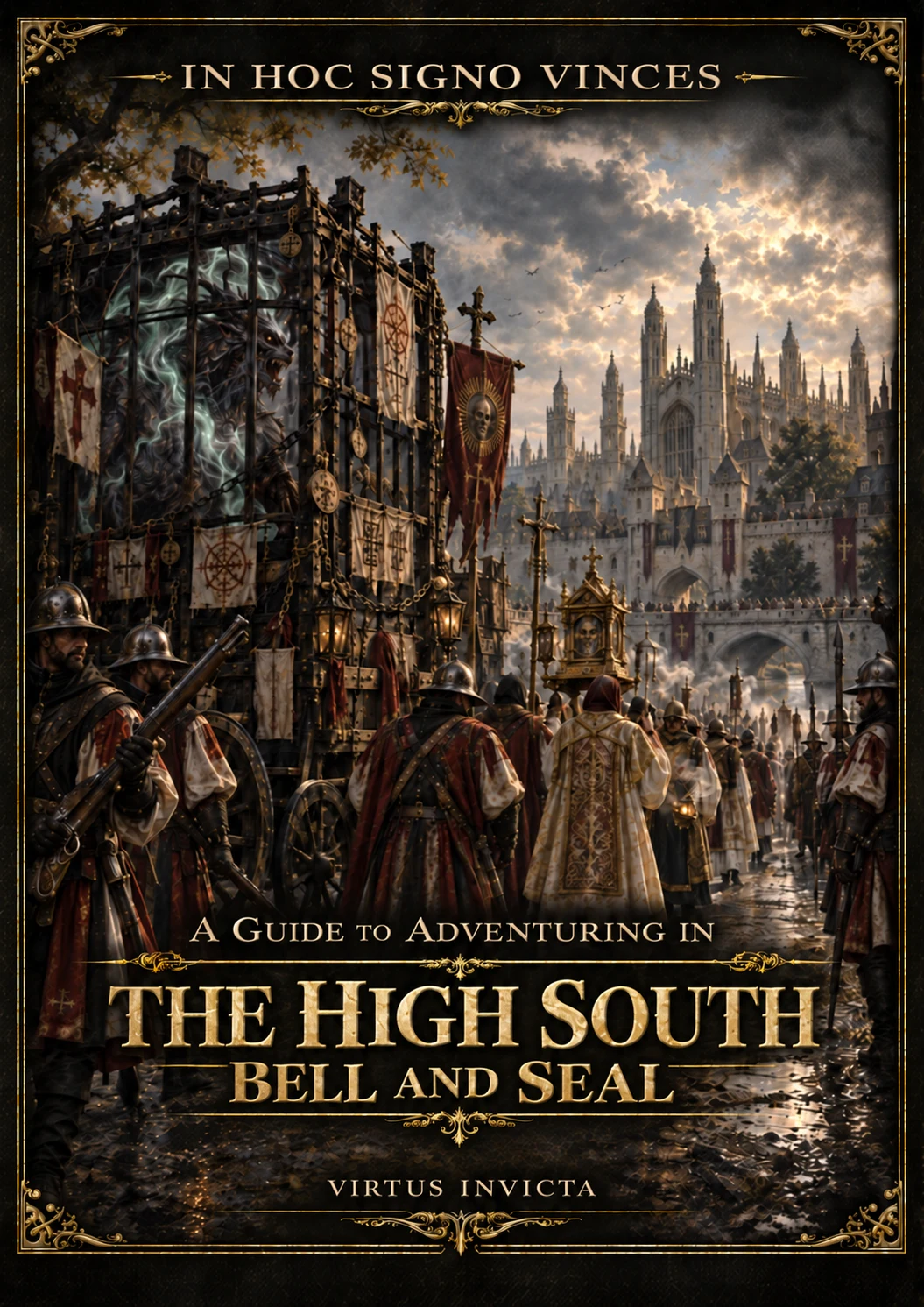
Book III
Bell and Seal
The High South, Oxford and Cambridge, and the Country Between — a public guide to the belt and the two authorities that hold it
“Ther ben houses in this vale that have taken in what the citee wolde not, and thei have doon it fourty yeer. I knowe wher thre of hem stonde. I have never writen it, and I never shal.”
“A bill bearing the wrong endorsement is worth more than a bill bearing none, because a bill bearing none is merely unlawful and a bill bearing the wrong one is a question that takes six months to answer.”
“Up here there is grass, sky, sheep and stone, and that is the whole inventory. It is the emptiest ground in the belt and it has more on it than the vale has, if you count what is under.”
From the opening
What the High South Is
The High South has no legal existence, and that want is the first thing to be understood about the belt. No charter names it, no officer holds it, no court sits for it, and no tax is levied in its name. Carriers use the word, and clergy, and the Westminster offices that must send their letters somewhere; nobody inside the region uses it of himself, so that a valleys man, a Cambridge man and a Sarrum man would each be mildly insulted to be collapsed into the other two. Yet the term endures, and it endures because it names what the formal county names do not: a run of country in which three different kinds of refusal overlap.
Those refusals, and not any line on a map, are the region’s true boundary. The Archbishopric of Oxford may refuse the dead a grave, the living a marriage, or a preacher his licence, and its reach runs down every tithe road in the valleys. The White Walls Assay Collegium at Cambridge may refuse a stone, an instrument or a formulary, and its refusal is honoured anywhere in the realm that cares whether a thing works. The drover courts of Sarrum may refuse a herd the road, which sounds the smallest of the three and is the one likeliest to ruin a man inside a season. Where all three can find a man in the same week, there the High South is.
Hence the belt reads smaller on the ground than on paper. A parish may lie well inside the drawn line and stand practically outside it, because the tithe road was broken by water nine years ago and the chapter has not troubled to argue. Another may lie beyond every reasonable boundary and be firmly inside, because its whole living depends on stone that must pass Cambridge before it can be sold. Authority here is measured in errands and not in acres, so that the region has no gate by which a man may enter it or leave it. It is entered by becoming answerable: by taking a contract, by seeing a kinsman buried, by buying a certified thing, or by moving animals. Until then a man may pass through the whole belt and meet nothing but civility, good roads, and the impression that he has seen a well-governed country. He has. He has simply not yet had occasion to test it.
The three refusals are best watched in a single case, for the region seldom produces them one at a time. A foundry at the eastern edge of the valleys wants to expand. It needs stone, which must be assayed at Cambridge; it needs the chapter’s consent to build on ground that holds graves, since almost all old ground here holds its dead; and it needs its ore and fuel brought over drove roads governed from Sarrum. Three bodies, three procedures, no common calendar, and no obligation on any of them to consider the other two: so the foundry-master’s year is spent travelling between them, and it is from such men that most of the belt’s hired work comes.
The formal county names still exist and still matter, for tax, for muster and for the courts, and a clerk will use them without exception. Yet no clerk imagines that they describe how the country works, and the ministries have quietly ordered their own correspondence around the belt for a century without once admitting in writing that they have done so.
Contents
Part I — The Belt and Its Two Authorities
- 1 The High South at a Glance
- 2 Tone, Weather, and the Aesthetic Logic of Inland Country Enhanced members
- 3 The Thames Corridor, the Marsh, and the Roads Between
Part II — Oxford
- 4 Approach, Streets, and the Cathedral Silhouette
- 5 The Chapter, the Archbishopric, and Ecclesial Rule Enhanced members
- 6 Colleges, Copyists, and the Schools That Refused the Standard Enhanced members
- 7 Severity and Shadow: the Writ, the Afflicted, and the Unlit Lanes Enhanced members
Part III — The Valleys, the Fields, and the Marsh
- 8 The Blessed Fields and the Tithe Country
- 9 Bells, Saints, and the Folk Religion of the Valleys Enhanced members
- 10 The Marsh at Oxford’s Edge: Causeways, Reeds, and Lantern Country
Part IV — Cambridge
- 11 White Walls, Yards, and the Sound of Measure
- 12 The Assay Collegium, the Schola, and What Certification Means Enhanced members
- 13 Manufacture, Novelty, and the Ingredient Market Enhanced members
- 14 Machine-Stone, Alchemy, and the Handling of Dangerous Material Enhanced members
- 15 Retrieval, Flight, and the Benefactors Enhanced members
- 16 Guarantor Rooms, Permits, and Classification Enhanced members
- 17 The Vaults, the Scandals, and the Unlicensed Benches Enhanced members
Part V — Rule, Houses, and the Powers in the Land
- 18 The Four Houses, the Small Nobility, and the Clearance Roll Enhanced members
- 19 Constabularies, Courts, and the Hue Enhanced members
- 20 The Hangers: Timber, Charcoal, Pannage, and the Woodmote
- 21 Concord, Cleansing, and the Ladies Enhanced members
- 22 The Black Stories Enhanced members
- 23 Crown Reach, County Right, and What the Belt Says of the Capital Enhanced members
Part VI — Townships, Valleys, and Settlements
Part VII — The Making of the Belt, and Doors Into It
- 27 Ruin, Return, and the Two Conformities Enhanced members
- 28 The Ground Before the Cities Enhanced members
- 29 The Making of Oxford Enhanced members
- 30 The Making of Cambridge Enhanced members
- 31 What People of the Belt Know and How They Survive It Enhanced members
- 32 Companies, Employments, and Doors into the Belt Enhanced members