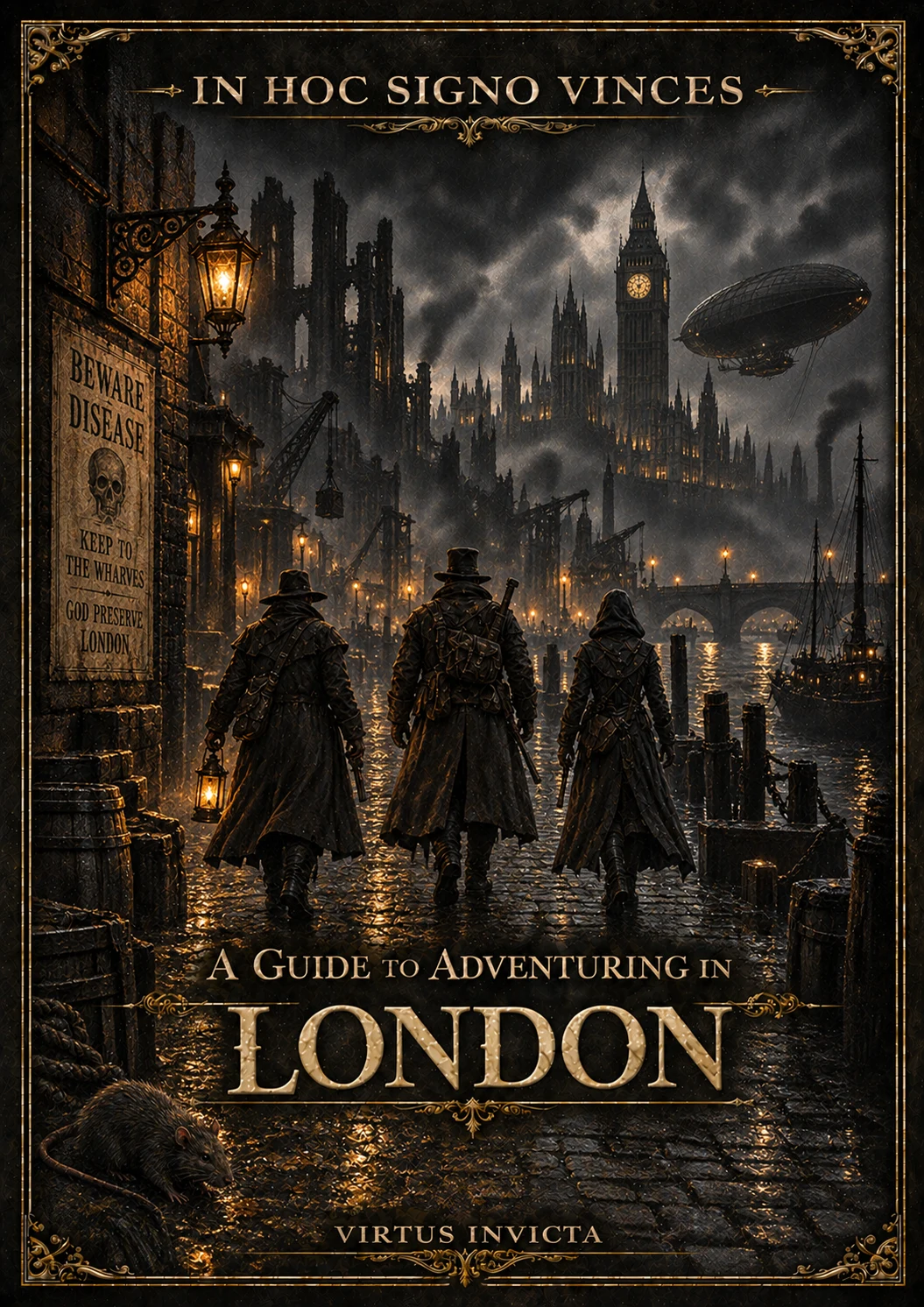
Book II
London
A public guide to London as the layered capital of Aerth: river, wards, Westminster, Crown, houses, companies, churches, undercity, danger, memory, and employment.
“Every honest river city lives by admission. Cargo is never merely cargo once tide, salvage, seal, and rumour have all laid hand upon it.”
“Every ward doth know the limit of its own reach, and every ward doth pretend otherwise until a hard winter proveth it.”
“London was not worth retaking because it was safe. It was worth retaking because too much of the realm’s future would otherwise have remained trapped in its ash, its river, and its remembered authority.”
From the opening
What London Is
“Who first asks what London is must reckon not the towers thereof but the multitude of obediences whereby hunger, rank, and fear are made to dwell together.”
London is the capital lens of Aerth: the place where river, labour, law, appetite, rank, and memory are forced to coexist at a scale nowhere else in Britannia quite matches. In a single sweep of the eye one may take in bridges, chimneys, church towers, bonded yards, petition routes, processional spans, and the dark water without which none of those things could be fed, lit, or explained. It is therefore not merely the greatest city of the realm, but the place in which the whole recovered age appears most concentrated.
The city is impressive because it makes difficult things look routine. Goods arrive, letters move, offices open, sermons are preached, petitions are heard, lamps burn, and funeral processions pass without the machine visibly showing all the effort required to hold it together. That appearance of mastered strain is one of London’s chief political assets. The capital persuades subjects, rivals, and newcomers alike by staging competence in public and pushing labour downward into stair, yard, quay, workshop, vestry, and maintenance court.
Yet London is never a simple triumph. It is layered, burdened, and visibly dependent. It drinks by the river, eats by the roads, breathes by the marshward fringes, and governs by systems whose stability can never be wholly assumed. It is not a city of effortless modernity but a city of disciplined interdependence, and any useful description of it must begin from that fact.
Newcomers also notice that London sorts arrival by route and by class. The man who enters over wet road from Kent meets posted rules, toll order, lodging pressure, and the smell of horse lines before he ever sees the great terraces. The traveller who comes upriver meets tar, shouting, cranes, customs marks, and tide-smell first. The one who descends by mast or royal carriage begins above the city and may mistake perspective for superiority, seeing smoke and towers before hearing the labour that keeps them alive. London thus teaches hierarchy not only by title but by approach. Where one enters determines what sort of capital one thinks he has come to.
Among the faces London half-admits are the Afflicted. They are rarely part of the city’s proud image, yet they are present in the lower service of the capital: at drains, bad stairs, furnace backs, corpse routes, hidden hospital doors, and underbridge rooms where useful hands matter more than clean lineage. A newcomer who never sees them has usually only seen the city from above.
Contents
Part I — The Capital and Its First Aspect
- 1 London at a Glance
- 2 Tone, Atmosphere, and the Aesthetic Logic of the Capital Enhanced members
- 3 The Lower Thames, the Basin, and the Approaches to London
- 4 The Layers of London and a Short Public Timeline Enhanced members
Part II — The Living Metropolis
- 5 The Commons: Streets, Wards, Markets, and Parishes
- 6 River London: Docks, Quays, Ferries, and Mud Stairs
- 7 Westminster, the High City, and the Public Face of Rule
- 8 The Crown City, Royal Palaces, and the Houses in London
- 9 Embassies, Mission Houses, and Foreign London
- 10 Guilds, Companies, Banks, and the Money City Enhanced members
- 11 Churches, Chapels, Shrines, and Sacred London Enhanced members
- 12 Arcane Arts, Artifice, Alchemy, and Metropolitan Industry Enhanced members
- 13 Daily Life, Labour, Servants, and the Cost of Living Enhanced members
Part III — Crown, City, and the Institutions That Keep London in Motion
- 14 The Crown in London: Realm Offices, Revenue, and Superior Authority Enhanced members
- 15 The Lady Mayor, Wards, Councils, and Practical Civic Rule Enhanced members
- 16 Militia, Watchmen, Guards, and the Layered Enforcement Stack Enhanced members
- 17 Law, Archives, Hospitals, and the Keeping of the Dead Enhanced members
- 18 The Afflicted, Custody, and London’s Receiving Role Enhanced members
- 19 Roads, Customs, Quarantine, Inspections, and the Movement of London Enhanced members
- 20 Skyports, Guarded Masts, and the Secret Sky Enhanced members
Part IV — The Shadow City
- 21 Taverns, Cellars, Opium Houses, Brothels, and Pleasure Streets Enhanced members
- 22 The Undercity: Old City, Gutters, Sewers, and Lawful Descent
- 23 Black Markets, Hidden Cults, Syndicate London, and Illicit Sovereignties Enhanced members
- 24 Rumours, Local Haunts, Blights, and Dangerous Encounters Enhanced members
Part V — The Making of London
- 25 Ancient London, Ruin, and the Long Return Enhanced members
- 26 The Rise of the Capital Enhanced members
Part VI — Knowledge, Companies, and Employment in the Capital
- 27 What Londoners Know and How They Survive It Enhanced members
- 28 Companies and Adventurers in London Enhanced members
- 29 Employments, Patronage, and Doors into the Capital Enhanced members